For most UK business owners, the first week of a new month isn’t a time for celebration or strategic planning. Instead, it’s a period of low-level dread. It’s the time when the “shoe-box” (digital or physical) of receipts needs to be reconciled, VAT must be accounted for, and the dreaded “month-end close” begins.
If you find yourself sitting at your desk on a Sunday night, staring at a Xero or QuickBooks dashboard that says your bank balance is £5,000 off from your actual statement, you aren’t alone. But you are stuck in a cycle that is actively hindering your growth.
The truth is, a slow month-end isn’t a sign that your business is “complex”.it’s a sign that your system is broken.
Why Is Your Month-End Always Late?
Why is it that despite all the modern accounting software available, most small and medium-sized enterprises (SMEs) in the UK still receive their financial reports twenty days after the month has ended?
By the time you see your Profit & Loss statement for March, it’s already the 22nd of April. Any insight that the report offered is already a month old. You’re essentially driving your business by looking only in the rearview mirror.
The Real-World Pain:
- The “Numbers Gap”: Why don’t the numbers on the screen match the reality of your bank account?
- The Time Sink: Bookkeeping is a high-cognitive-load task that usually gets pushed to the end of the day. You’re doing it when you’re tired, which leads to errors, which leads to more time spent fixing those errors.
- Missed Decisions: You want to hire a new developer or invest in a new marketing campaign, but you’re waiting on the “final” numbers to see if you have the cash flow. By the time the numbers arrive, the candidate has another offer.
The month-end isn’t slow because accounting is hard; it’s slow because your data isn’t being managed in real-time.
The Real Reason Your Books Feel Out of Control
To fix the stress, we have to move past surface-level symptoms and look at the structural failures in the DIY or “low-cost” bookkeeping model.
1. Your Bank Doesn’t Match Your Books
Bank reconciliation is the foundation of all accounting. If this is off, everything else is a lie. Discrepancies usually happen because of missing transactions, duplicate entries, or timing gaps (like a payment made on the 31st that doesn’t clear until the 2nd). When you leave reconciliation to a once-a-month task, you have to investigate 30 days of history at once. That is where the “chaos” begins.
2. VAT Coding Errors Are Silently Costing You
VAT is perhaps the most scrutinized area for UK businesses. Misclassifying an expense (e.g., claiming 20% VAT on something that should be Zero-rated) isn’t just an “oops”.it’s a compliance risk. HMRC is increasingly automated; they notice patterns. If your VAT coding is inconsistent, you are effectively waving a red flag for an audit. Furthermore, if you miss claiming VAT on valid expenses, you are literally leaving money on the table.
3. Month-End Is Treated Like a Last-Minute Task
If you treat the close like a homework assignment due at midnight, you will always be stressed. Without a structured, daily, or weekly workflow, the workload piles up.
The Insight: These aren’t separate issues. Bank recs, VAT, and the month-end close are part of a single, interconnected chain. If one link is weak, the whole system fails.
What a Proper Monthly Close Should Actually Look Like?
It’s time to reset your expectations. You shouldn’t be waiting three weeks for reports. A “Clean Books” system operates on a much tighter schedule.
The Ideal Timeline:
- Day 1–2: All transactions from the previous month are captured and categorized.
- Day 3–4: Bank reconciliation is finalized, and any “mystery” transactions are solved.
- Day 5: Your monthly reports (P&L, Balance Sheet, Cash Flow) are in your inbox.
What You Should Receive:
- Accurate P&L: Knowing exactly what you earned and what you spent.
- Cash Flow Visibility: Understanding where your money is tied up.
- VAT-Ready Data: Knowing exactly what your VAT liability is before the quarter ends.
Why most UK businesses never reach this stage: They rely on “reactive” bookkeeping doing the work only when a deadline looms rather than “proactive” management.
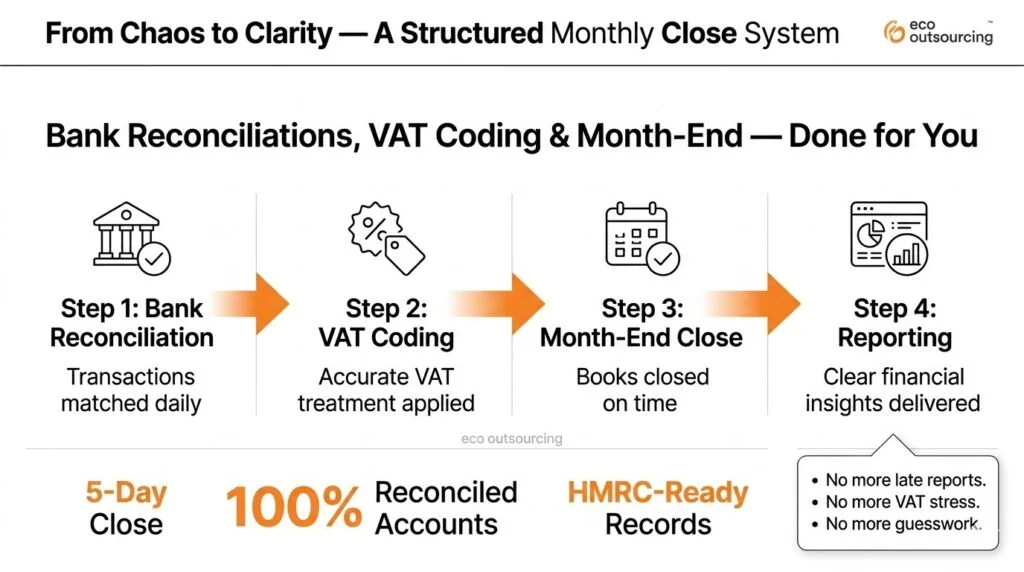
The Clean Books System. (How It All Connects)
When you look for outsourced bookkeeping services in the UK, you shouldn’t just be looking for someone to “type in numbers.” You need a system that integrates three core steps.
Step 1 – Bank Reconciliation (The Foundation)
We don’t wait until the end of the month. By reconciling your accounts weekly, we catch errors while the memory of the transaction is still fresh. This prevents the “mystery £40 charge” from becoming a two-hour investigative project three weeks later.
Step 2 – VAT Coding (The Compliance Layer)
Every transaction is coded with its specific UK VAT treatment. We ensure that you are claiming every penny you are entitled to while remaining strictly compliant with HMRC’s Making Tax Digital (MTD) requirements.
Step 3 – Month-End Close (The Output)
Because Steps 1 and 2 happen throughout the month, the “Close” is simply a final verification. This allows for clean, decision-ready reports to be generated in days, not weeks.
When these three work together, the month-end becomes a non-event.
Messy Books vs. Clean Books (Before vs. After)
The Messy Books Reality:
- Day 1–10: Chasing invoices and wondering why the bank doesn’t balance.
- Day 11–20: Back-and-forth emails with the accountant fixing “suspense account” entries.
- Day 20+: Finally getting reports that tell you what happened 50 days ago.
- Result: High stress, constant delays, and decisions made on “gut feel” rather than data.
The Clean Books Reality:
- Day 1–3: All accounts reconciled; everything is in its right place.
- Day 4–5: Management reports are delivered and reviewed.
- Result: Clarity, 100% confidence in your cash position, and the ability to scale.
The Hidden Cost of Messy Bookkeeping
“I’ll just do it myself to save money” is often the most expensive sentence in business.
- HMRC Penalties: Late or incorrect VAT filings can result in surcharges of up to 15% of the tax due.
- Accountant Cleanup Costs: Your year-end accountant will charge you a premium to fix a year’s worth of messy bookkeeping before they can even start your tax return.
- Lost Time: If you spend 10 hours a week on admin, and your hourly value to the business is £100, that’s £4,000 a month in “lost” growth.
- The “Blindness” Cost: If you don’t realize a specific product line is losing money until six months later, that’s pure capital down the drain.
Common Misconceptions About Bookkeeping (Debunked)
“Bookkeeping is just data entry.”
- Reality: It is financial control. Data entry is about the past; financial control is about the future.
“Software will handle everything.”
- Reality: Xero and QuickBooks are amazing tools, but they are “garbage in, garbage out” systems. If you code a personal holiday as a business expense, the software won’t stop you but HMRC will.
“VAT is simple.”
- Reality: Between partial exemption, reverse charges, and different rates, VAT is a minefield. One mistake can trigger an audit that takes months to resolve.
“Outsourcing means losing control.”
- Reality: You actually gain control. You stop being the “worker” in the finance department and start being the “CEO” who reviews the results.
What Done-for-You Bookkeeping Actually Includes
When we talk about outsourced bookkeeping services in the UK, we mean a comprehensive package that takes the burden entirely off your shoulders.
| Feature | What It Means For You |
| Full Bank Reconciliation | Your software and bank match 100%, 100% of the time. |
| Accurate VAT Coding | Records are kept in an HMRC-compliant format, ready for MTD filings. |
| Monthly Close & Reporting | You receive a P&L and Balance Sheet by the 5th working day. |
| Error Detection | We spot duplicates or missing invoices before they become a problem. |
What If Your Books Are Already Messy or Behind?
Many clients come to us with a “backlog.” They haven’t reconciled in four months, and the VAT deadline is in two weeks.
You are not alone. Most businesses reach a “breaking point” where they realize they can no longer handle the complexity themselves. We offer Catch-Up Bookkeeping to clean up historical data, fix prior errors, and get your records HMRC-ready before we transition you into our monthly “Clean Books” system.
Outsourced Bookkeeping vs. DIY vs. In-House
Choosing the right path for your finance function depends on your scale, but for most SMEs, the middle ground is the “sweet spot.”
- DIY Bookkeeping: It’s “free,” but it’s error-prone and steals your most valuable asset: time.
- In-House Bookkeeper: Very effective, but expensive. In the UK, a competent bookkeeper costs £30k–£40k+ plus benefits, desk space, and NI.
- Outsourced Bookkeeping Services UK: You get the expertise of a high-level team for a fraction of the cost of a full-time hire. It’s scalable as you grow, we grow with you.
Will You Lose Control by Outsourcing?
This is a common fear. “If someone else is doing the books, how do I know where my money is?”
Actually, you gain Real-Time Visibility. Because we keep the books updated weekly, you can log into your software at any time and see a true reflection of your business. You get transparency without the toil. We provide regular reporting and clear communication, acting as an extension of your team, not a black box.
How the Process Works: From Chaos to Clarity?
We believe in transparency. Here is how we transition a client into a stress-free month-end:
- Step 1 – Onboarding & Review: We look at your current setup, your software, and identify any immediate “red flags.”
- Step 2 – Clean-Up: If you have a backlog, we roll up our sleeves and fix it. We make sure the “opening balances” are 100% correct.
- Step 3 – Monthly Workflow Setup: We establish how you’ll send us invoices (usually via a simple app) and how we’ll communicate.
- Step 4 – Ongoing Management: We handle the daily/weekly heavy lifting. You simply review the reports at the end of the month.
Signs You Need Outsourced Bookkeeping Services in the UK
If you recognize any of these patterns, it is time to stop doing it yourself:
- Your books are always at least one month behind.
- The term “VAT Return” makes you feel physically ill.
- You have “mystery” money in your bank account that you’re afraid to spend.
- You spend your weekends doing admin instead of resting or growing the business.
- Your accountant complains that your data is a mess at year-end.
How Clean Books Help You Make Better Business Decisions?
At the end of the day, bookkeeping isn’t about the numbers.it’s about confidence.
With real-time insights, you know exactly how much you can afford to invest. You have better cash flow control, meaning you never have to worry about the payroll run. You can make growth decisions based on facts, not a “feeling” about how much is in the bank.
How eco outsourcing Simplifies Your Month-End?
At eco outsourcing, we don’t just complete bookkeeping tasks. We manage your entire monthly close system so everything runs smoothly and on time. We handle bank reconciliations regularly to ensure your numbers always match, apply accurate VAT coding to keep your records compliant and stress-free, and follow a structured month-end process to deliver clear, reliable reports when you actually need them. From reviewing and cleaning up your books to maintaining a consistent workflow each month, we make sure there are no last-minute surprises. The result is faster closings, accurate financial data, and full visibility without you having to deal with the complexity.
FAQS(Frequently Asked Questions)
What is bank reconciliation and why does it matter for my business?
Bank reconciliation is the process of matching your business’s internal financial records against your actual bank statements to ensure they agree. It matters because it catches errors, identifies missing transactions, flags duplicate payments, and gives you a true picture of your cash position. Without regular reconciliation, small discrepancies can snowball into significant financial blind spots that are costly and time-consuming to untangle later.
How often should bank reconciliations be done for a UK business?
Ideally, bank reconciliations should be completed weekly rather than left until month end. Weekly reconciliation keeps your records clean and current, making the month-end close process significantly faster. Businesses that only reconcile monthly often discover errors too late, creating backlogs that delay reporting and increase the risk of VAT mistakes and missed payments.
What is VAT coding and why do so many UK businesses get it wrong?
VAT coding is the process of assigning the correct VAT treatment to every transaction in your accounts whether that is standard rate, zero rate, exempt, or outside the scope of VAT. It is one of the most commonly mishandled areas of bookkeeping because different expenses and income streams carry different VAT rules. Getting it wrong leads to overclaiming or underclaiming VAT, which can trigger HMRC penalties and interest charges.
What does a proper month-end process actually involve?
A thorough month-end close covers bank reconciliation, VAT coding review, accounts payable and receivable reconciliation, payroll posting, accruals and prepayments, fixed asset updates, and the production of management accounts. When done correctly, it gives business owners an accurate and timely snapshot of their financial performance enabling smarter decisions rather than relying on outdated or incomplete figures.
What are the risks of handling bank reconciliations, VAT coding, and month-end in-house without specialist support?
The risks are significant. Untrained staff may miscategorise transactions, apply incorrect VAT codes, or miss cut-off entries all of which distort your financial picture and create compliance exposure. In-house teams are also vulnerable to backlogs during busy periods, leading to delayed reporting. The cumulative effect of these errors often only becomes apparent at year-end, by which point the cost of correction far exceeds what outsourced support would have cost throughout the year.
How does outsourcing bank reconciliations, VAT coding, and month-end save UK businesses time and money?
Outsourcing these functions to a specialist provider eliminates the need for dedicated in-house bookkeeping staff, reduces the risk of costly errors, and ensures your books are always close-ready. You benefit from experienced professionals using best-in-class cloud accounting tools, consistent processes, and timely delivery freeing you and your team to focus entirely on running and growing the business rather than managing financial admin.
Conclusion
Ready to Take the Stress Out of Month-End?
You did not start your business to become a part-time bookkeeper. You started it to solve a problem, create a product, or serve a client base and that is exactly where your energy and focus should remain.
At Eco Outsourcing, our Done-for-You bookkeeping system is designed to give you back your time and your peace of mind. From bank reconciliations and VAT coding to a clean, timely month-end close, we provide a reliable, accurate, and efficient finance function that grows and scales alongside your business.
Stop fighting with spreadsheets and chasing missing invoices. Start leading your business with confidence, backed by numbers you can actually trust.
Get in touch with Eco Outsourcing today and discover how easy the month-end can be when the right team is handling it for you. read more