Home security is not a new phenomenon. Humans have looked for ways to best secure their residences for centuries. In prehistoric eras, animals were used to ward off intruders, and large boulders were placed to protect people while they slept. In the early 1700s, an intrusion alarm linking doors with chimes was created, and in the 1800s, the first electromagnetic alarm was created. The modern-day home security system with closed-circuit television monitoring was invented in the 1960s, with innovations leading to motorized tracking cameras and integrated intercom systems.
Through all of these iterations, one constant remains: protecting the home to the best of your ability. It only makes sense that in today’s digital-focused world, home security systems are advancing. AI-powered cameras, smart sensors, and automation are shifting how homes are protected, from the inside out.
Read on to learn how home security technology is evolving and what homeowners should look for in a smart security system.
Comprehensive Integration
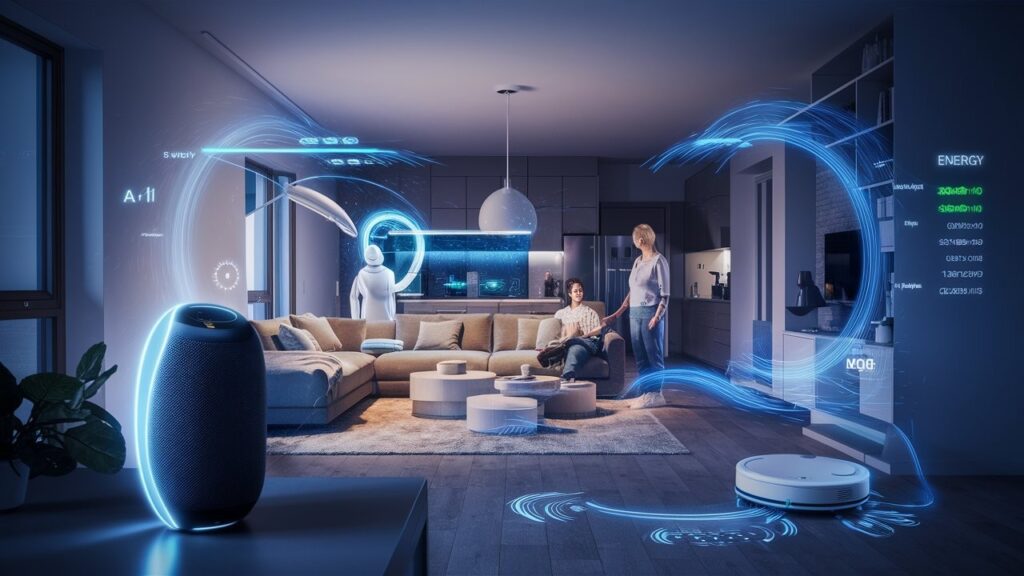
The beauty of modern-day technology is how interconnected it is. Amazon Alexa and Google Assistant can be programmed to turn lights on and off, adjust thermostats, and even turn appliances on and off. Smart thermostats can adjust heating and cooling to your preferences on your mobile devices. The same is true with the latest security systems.
Real-time alerts can be sent to a user’s phone via doorbells and monitoring cameras. When you’re at the office, you can see if a package was delivered and if your dog walker came in when they were expected to arrive. You can even monitor your home’s safety when you’re across the world, lying on a tropical beach for a family getaway.
Integration enables every security device in your home — from cameras to sensors to lighting to smart locks — to work together automatically. This means less time worrying if you’ve checked in on every device and more time feeling at ease knowing that your home is safe and secure. The capabilities are only just beginning as the Internet of Things (IoT) continues to revolutionize, and smart devices only become more efficient and effective.
AI and Predictive Analytics
When you think of AI, you may first think of how ChatGPT or Gemini allows you to quickly draft an appropriate response to an email, or help you maximize your vacation time by seeing the top sights in a new destination. But modern security systems are leaning into AI as well.
AI-powered home security systems use a combination of AI, machine learning algorithms, and computer vision to provide more proactive protection. This transforms security from being passive to more dynamic in nature.
Its capabilities include distinguishing a false threat from a passing squirrel to an actual human. Sensors and cameras can also analyze footage in real-time, tracking the car that keeps circling the block and sending a proactive alert to your mobile device. This is an evolution from basic motion detection sensors that picked up just about anything that was crossing your front door.
Cameras can even use biometric authentication technology to learn certain faces, such as family members, neighbors, and even the UPS delivery person. Facial recognition adds a layer of security, ensuring that a homeowner knows the person approaching the door. Voice recognition allows homeowners to control their home’s system with a few simple voice commands.
Moreover, with predictive analytics technology, homeowners can be more responsive to real threats rather than waste time and energy on a false alarm. The system will learn habits and behaviors of residents, anticipating when someone is likely to come home and open the garage, and when this act is out of character. It can even distinguish suspicious activities, sending immediate alerts. This advanced level of surveillance creates alerts when an actual threat is at hand, ensuring that the homeowner pays attention instead of dismissing it as another false threat.
Read More: Smart Homes & Interiors: The Future of Living
Conclusion: What to Look for in a Home Security System
The right home security system can provide you and your family with increased protection and better peace of mind. But if you do a quick Google search, the number of security systems available may be intimidating. Doing some research and comparing what’s available can save you time, money, and energy in making the right decision.
First, only look at options that are available within your specific zip code. There’s no need to waste time researching one model only to discover that it’s unavailable in your region. Second, do an analysis of your home and what is necessary from a security perspective. If you have a standalone home with multiple entryways, you’ll likely need something different compared to someone in a condominium building.
Lastly, take some time looking at your budget and evaluating what you can afford. The newer models with all the bells and whistles may sound great, but if you’re pinching pennies to purchase it, then it may not be the best decision for you right now.
Additionally, make sure to purchase a system that works well with the current technology you own. If you purchase a system that only works with an Apple product, but you own a Google product, then it may not be the wisest choice. The research you put into your decision now will pay off as you enjoy all the benefits of homeownership, safely and securely.