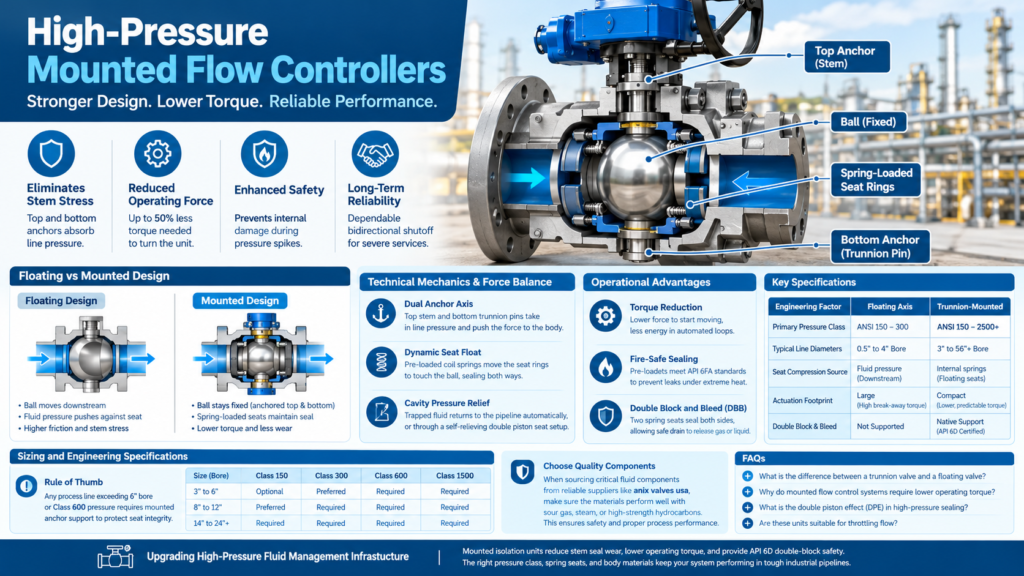
High-pressure mounted flow controllers eliminate structural stem stress by securing the internal ball using top and bottom anchors. Unlike floating designs, incoming line pressure forces spring-loaded seat rings directly against a fixed central axis. This configuration reduces the mechanical operating force needed to turn the unit by up to 50%.
Furthermore, maintaining absolute seat alignment prevents severe internal component damage during extreme pressure spikes. When sourcing critical fluid components from reliable suppliers like anix valves usa, this robust anchor architecture ensures long-term operational integrity and dependable bidirectional shutoff for severe industrial services.
Technical Mechanics & Force Balance
Standard floating designs let the ball move downstream and push against the seat face. When the pressure exceeds ANSI Class 300, this can cause a lot of friction and can bend the stem.
Mounted designs fix this. They keep fluid force away from the moving round parts.
- Dual Anchor Axis: The top stem and bottom trunnion pins take in the line pressure and push the force right to the body casting.
- Dynamic Seat Float: Pre-loaded coil springs move the steel or PTFE seat rings to touch the still ball. This keeps a seal going both ways, at both low and high pressure.
- Cavity Pressure Relief: When fluid gets trapped, it goes back into the pipeline on its own, or through a self-relieving double piston seat setup, if inside pressure gets higher than the seat spring force.
Operational Advantages Across Severe Services
High-pressure jobs need steady torque and strong safety. Mechanical anchoring helps cut the total cost because it does not need big and pricey air-powered actuators.
- Torque Reduction: Taking in push from the top and bottom bearings helps lower the force needed to start moving. This cuts down on energy used in automated loops.
- Fire-Safe Sealing: Extra contact points between metal seats meet API 6FA standards. They help stop fluid from escaping quickly if soft inserts break down due to heat.
- Double Block and Bleed (DBB): Two spring seats seal both sides at the same time. This allows people to safely let gas or liquid out through drain ports when the pipeline is working.
Structural Selection & Specification Matrix
| Engineering Factor | Floating Axis Design | Trunnion-Mounted Axis |
| Primary Pressure Class | ANSI Class 150 – 300 | ANSI Class 150 – 2500+ |
| Typical Line Diameters | 0.5″ to 4″ Bore | 3″ to 56″+ Bore |
| Seat Compression Source | Fluid pressure pushing sphere downstream | Internal helical springs driving floating seats |
| Actuation Footprint | Large (High break-away torque) | Compact (Lower, predictable torque) |
| Double Block & Bleed | Not Supported | Native Support (API 6D Certified) |
Sizing and Engineering Specifications
Rule of Thumb: Any process line exceeding 6″ bore or Class 600 pressure requires mounted anchor support to protect seat integrity.
If you want to take tough components from sources such as anix valves usa, then you need to be sure that the components will perform well with sour gas, steam, or high-strength hydrocarbons. This will ensure safety and proper process performance.
| Size (Bore) | Class 150 | Class 300 | Class 600 | Class 1500 |
| 3″ to 6″ | Optional | Preferred | Required | Required |
| 8″ to 12″ | Preferred | Required | Required | Required |
| 14″ to 24″+ | Required | Required | Required | Required |
FAQs
What is the difference between a trunnion valve and a floating valve?
The trunnion valve keeps the ball fixed both in its upper part and in its lower part. The only moving part in the valve is the seat ring. The floating valve does not fix the ball; therefore, the fluid pressure forces the ball to move in the downstream direction towards the seat.
Why do mounted flow control systems require lower operating torque?
The top stem and bottom pin take in the line pressure. This lets the sphere move smoothly on the bearings. It does not drag a lot on the seat faces.
What is the double piston effect (DPE) in high-pressure sealing?
DPE uses line and hole pressure to push both seats, in front and behind, against the sphere at the same time. This makes a backup seal if the main seat does not work.
Are these units suitable for throttling flow?
No. Mounted units that turn a quarter are made to be either fully open or fully closed. They are used to stop or let the flow through. If you try to control the flow, the seat faces get hit by fast-moving fluid. This can wear them out and can also cause heat damage.
Upgrading High-Pressure Fluid Management Infrastructure
Using mounted isolation units can help lower stem seal wear. It also reduces the torque needed to operate the valve. This provides clear API 6D double-block safety. Picking the right ANSI pressure classes, spring seats, and body materials helps your system work well for a long time in tough industrial pipelines.