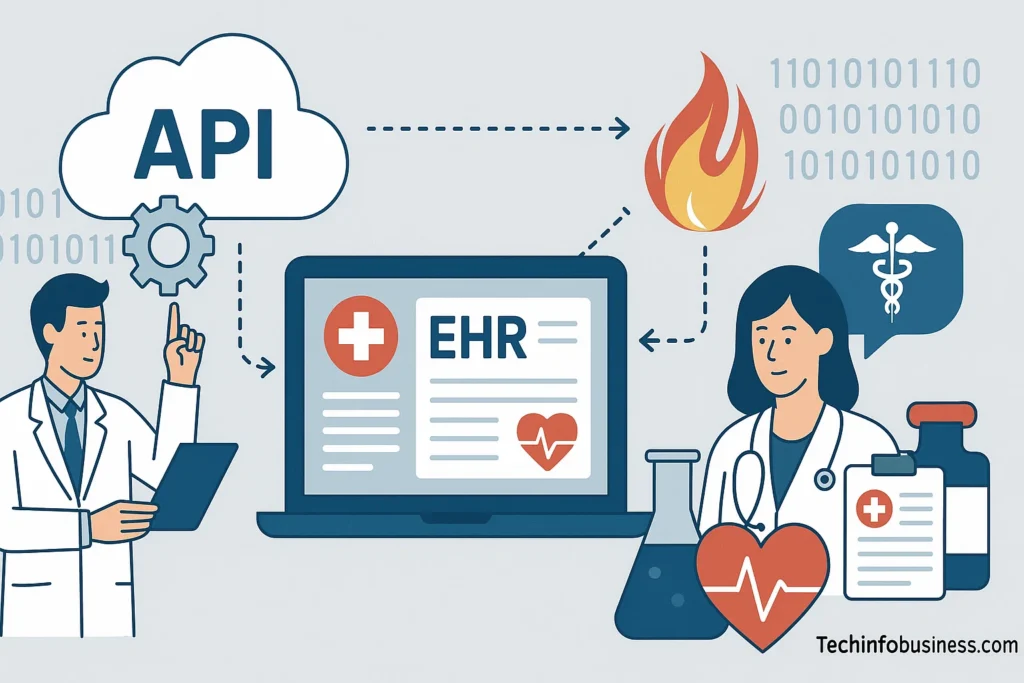
Healthcare systems generate vast amounts of data, but much of it remains siloed, hindering patient care and clinical insights. APIs, particularly the FHIR standard, are revolutionizing interoperability by enabling secure, real-time data exchange across hospitals, clinics, and other providers.
Understanding APIs in Healthcare Context
Application Programming Interfaces serve as digital bridges that enable different healthcare software systems to communicate and share information automatically. Unlike manual data transfer methods that require human intervention and are prone to errors, APIs create direct, programmatic connections between systems that can exchange information in real-time or on-demand.
Healthcare APIs operate by translating data from one system’s format into standardized formats that other systems, including medical software, can understand and process. When a laboratory completes blood work for a patient, an API can automatically transmit those results to the patient’s primary care physician’s electronic health record system, eliminating delays and reducing the risk of lost or misplaced information.
The technical architecture of healthcare APIs must address unique challenges including patient privacy protection, data security, clinical workflow integration, and regulatory compliance. These APIs must handle sensitive personal health information while maintaining high availability and performance standards that support critical healthcare operations.
Authentication and authorization mechanisms within healthcare APIs ensure that only authorized healthcare providers can access specific patient information. These security layers verify user identities and enforce granular permissions that control which data elements each user can view, modify, or share with other systems.
Real-time data synchronization capabilities enable healthcare APIs to maintain current, accurate patient information across multiple systems simultaneously. When a patient’s medication list is updated in one system, APIs can automatically propagate those changes to all connected systems, ensuring that every healthcare provider has access to the most recent information.
FHIR: The Game-Changing Healthcare Data Standard
Fast Healthcare Interoperability Resources (FHIR) represents the healthcare industry’s most significant advancement in data standardization and interoperability. Developed by Health Level Seven International (HL7), FHIR provides a comprehensive framework for organizing, formatting, and exchanging healthcare information that addresses the complex requirements of modern medical care.
FHIR organizes healthcare data into standardized “resources” that represent specific clinical concepts such as patients, practitioners, medications, observations, and care plans. Each resource follows consistent formatting rules that ensure information can be interpreted correctly regardless of which system originally created or currently stores the data.
The standard’s RESTful API architecture makes FHIR accessible to modern web and mobile applications while maintaining the security and reliability requirements essential for healthcare environments. Developers can build FHIR-compliant applications using familiar web technologies, significantly reducing the technical barriers to healthcare innovation.
Versioning capabilities within FHIR enable the standard to evolve and improve over time while maintaining backward compatibility with existing implementations. Healthcare organizations can adopt newer FHIR versions at their own pace without breaking existing integrations or requiring simultaneous updates across all connected systems.
Clinical terminology integration allows FHIR to incorporate established medical coding systems such as SNOMED CT, LOINC, and ICD-10. This integration ensures that clinical concepts are represented consistently and can be understood by healthcare providers regardless of their specific electronic health record system or clinical specialization.
Breaking Down Healthcare Data Silos
Healthcare data silos emerge when different departments, specialties, or organizations use incompatible systems that cannot share information effectively. These silos create dangerous gaps in patient care where critical medical history, test results, or treatment plans may not be available when needed most.
APIs address data silos by creating standardized interfaces that enable previously incompatible systems to exchange information seamlessly. A patient’s cardiac catheterization results from a specialized cardiology center can be automatically transmitted to their primary care physician’s EHR system, ensuring that all providers have complete visibility into the patient’s cardiovascular health status.
Emergency medicine scenarios particularly benefit from API-driven interoperability. When patients arrive at emergency departments unconscious or unable to communicate their medical history, APIs can provide immediate access to critical information such as current medications, known allergies, previous procedures, and chronic conditions from their regular healthcare providers.
Specialty care coordination becomes dramatically more efficient when APIs enable automatic sharing of referral information, diagnostic results, and treatment plans between primary care providers and specialists. Patients no longer need to carry physical copies of test results or repeat expensive diagnostic procedures because their information was unavailable to consulting physicians.
Population health initiatives rely on APIs to aggregate and analyze health data across large patient populations while maintaining individual privacy protections. Public health organizations can monitor disease trends, vaccination rates, and health outcomes by accessing de-identified data through secure API connections with healthcare providers throughout their regions.
Security and Privacy in API-Based Health Data Exchange
Healthcare APIs must implement multiple layers of security protection to safeguard sensitive patient information during transmission and access. Encryption protocols protect data both in transit and at rest, ensuring that patient information remains secure even if network communications are intercepted or storage systems are compromised.
Authentication mechanisms verify the identity of users and systems requesting access to patient data through APIs. Multi-factor authentication requirements add additional security layers that prevent unauthorized access even if login credentials are compromised. These systems must balance security requirements with usability to avoid creating barriers that interfere with clinical workflows.
Authorization controls determine which specific data elements each authenticated user can access through healthcare APIs. Role-based permissions ensure that healthcare providers can only access patient information necessary for their specific clinical responsibilities, while patients can control which providers have access to their personal health information.
Audit logging capabilities create comprehensive records of all API access to patient data, enabling healthcare organizations to monitor system usage, investigate potential security incidents, and demonstrate compliance with privacy regulations such as HIPAA. These logs must be tamper-resistant and maintained for extended periods to support regulatory requirements.
Data minimization principles guide API implementations to transmit only the specific information needed for each particular use case rather than entire patient records. This approach reduces privacy risks while improving system performance and reducing network bandwidth requirements.
Regulatory Compliance and API Standards
Healthcare APIs must comply with numerous regulatory requirements that govern the privacy, security, and appropriate use of patient health information. The Health Insurance Portability and Accountability Act (HIPAA) establishes fundamental privacy and security requirements that affect how APIs can collect, store, transmit, and access patient data.
The 21st Century Cures Act has accelerated API adoption in healthcare by requiring healthcare providers to make patient data available through standardized APIs. These regulations prohibit information blocking practices and establish patient rights to access their own health information through third-party applications of their choosing.
Certification requirements ensure that healthcare APIs meet established technical and security standards before they can be used in clinical environments. Organizations such as the Office of the National Coordinator for Health Information Technology (ONC) establish certification criteria that validate API functionality, security, and interoperability capabilities.
International standards such as FHIR provide globally recognized frameworks for healthcare API development that ensure consistency and interoperability across different countries and healthcare systems. These standards facilitate cross-border healthcare delivery and medical research collaboration while maintaining appropriate privacy protections.
Quality assurance processes validate that healthcare APIs perform reliably under various conditions and maintain data integrity throughout all exchange processes. Regular testing, monitoring, and validation help ensure that API-enabled systems continue to meet clinical and regulatory requirements as they evolve over time.
Conclusion
Healthcare APIs and FHIR standards are revolutionizing care delivery by enabling seamless data sharing, better care coordination, and clinical innovation. These technologies support patient-centered healthcare by facilitating interoperability, leveraging AI and predictive analytics, and empowering patients with greater control over their health data.