Asphalt striping and pavement marking is a service where quality variation between contractors is significant — and where the lowest bid often produces the shortest-lived result. Understanding what distinguishes professional striping from mediocre work helps property managers make decisions they won’t regret in 18 months.
Equipment and Materials
Asphalt striping company salt lake city that produce durable work use professional airless spray equipment calibrated for consistent film thickness and glass bead application. The paint quality matters as much as the application — commercial-grade traffic paint formulated for Utah’s temperature range and UV exposure levels performs significantly better than materials that aren’t engineered for local conditions.
The Pavement Coatings Technology Council provides technical standards for traffic marking materials and application practices, including specifications for paint quality and application thickness that are relevant for evaluating striping contractor practices.
Surface Preparation
Striping applied over dirty, oily, or wet pavement fails prematurely — the paint doesn’t bond adequately and the glass bead reflectivity is compromised. Professional contractors clean surfaces before application and verify that conditions (temperature, humidity, recent rainfall) are appropriate for the materials being applied.
Salt Lake City’s climate presents specific challenges here. Summer temperatures can push pavement surfaces well above 130°F, which affects how quickly paint dries and how well glass beads embed into the coating. Applying striping during the hottest part of a July afternoon often produces inferior adhesion compared to early morning or evening application when surface temperatures are more moderate. Experienced contractors in this market know the local timing windows and plan their schedules around them rather than pushing through jobs during suboptimal conditions.
Winter presents the opposite problem. Snowplow activity, road salt, and repeated freeze-thaw cycles take a heavy toll on pavement markings. Lines that were crisp in September can be faded or partially scraped away by March. Knowing this, professional contractors apply at the appropriate mil thickness and use paint formulations rated for cold-weather durability rather than standard products designed for milder climates.
Layout Accuracy
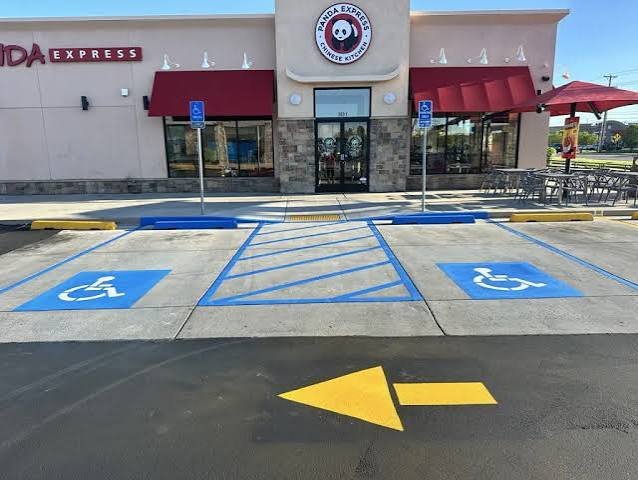
Parking lot striping requires accurate layout — consistent stall widths, proper aisle widths, correctly positioned accessible spaces, and properly aligned fire lane markings. Contractors who rush the layout phase produce lots with uneven stalls, misaligned rows, and wasted space that reduces the lot’s effective capacity.
ADA compliance is a critical component of this layout work. The number of accessible spaces required, their dimensions, the placement of access aisles, and the signage specifications are all governed by federal standards that property managers are legally responsible for meeting. A striping contractor who doesn’t account for current ADA requirements during the layout phase can leave a property owner exposed to compliance violations and potential liability. Asking a contractor how they handle accessible space layout and whether they stay current on ADA requirements is a reasonable and important question during the bidding process.
Evaluating Contractor Quality
References and completed project photos are the most reliable indicators of contractor quality. A company willing to show recent work — not stock photos or projects from five years ago — demonstrates confidence in their current output. Asking for two or three local references and actually calling them gives property managers direct insight into the contractor’s reliability, communication, cleanup practices, and whether the finished work matched what was promised during the estimate.
Pricing transparency matters too. A detailed estimate that breaks out surface preparation, paint type, linear footage, stencil work, and ADA-compliant space layout gives the property manager a clear picture of what they’re paying for. A single lump-sum number with no line items makes it difficult to compare bids accurately or understand where a contractor might be cutting corners to hit a lower price point.
Read Also: techinfobusiness.com