
From halls of residence conversations to late-night corridors, research suggests that understandable speech can be more disruptive than noise itself. Earmuffz is bringing laboratory-tested noise reduction to students who want more control over what they hear.
London, 21 August 2026 – As students prepare to head back to university, the usual checklist covers laptops, bedding, storage, toiletries and everything else needed to settle into term. One thing rarely makes the list: how to deal with noise.
Earmuffz, a specialist in certified noise reduction, is making the case that it should. For the 2026/27 academic year, the brand is highlighting something measurable rather than making broad promises about “blocking noise.” Its products carry certified noise-reduction ratings, meet EN 352-2, CE and ANSI standards, and were tested in accredited laboratories in 2025. The scale of the back-to-uni market is hard to ignore. A record 577,725 students were accepted onto UK undergraduate courses in the 2025 cycle, according to UCAS, joining a total student population of 2.86 million at UK universities. At the same time, UCAS’s Student Lifestyle Report puts average student spending at £219 per week on essentials, lifestyle and socialising once term begins.
Students are already spending considerably to prepare for moving into halls. Earmuffz’s argument is simple: controlling the noise around them deserves a place on that preparation list too.
Why conversations are so hard to tune out
For a student trying to read, write or revise in halls, library or shared flat, the issue is not simply how many decibels are in the room. The type of sound matters too. Research into what is known as the irrelevant speech effect has repeatedly found that background conversations can interfere with tasks that require concentration and memory. The reason is fairly straightforward: when people around us are talking, our brains do not simply treat those words as meaningless background sounds. Some of that speech continues to compete for our attention, even when we are actively trying to ignore it.
A large review of the research, covering 242 studies and 13,887 participants, found that background speech had a substantially greater effect on task performance than non-speech sounds. The impact was particularly noticeable when the task required accuracy. Another meta-analysis of 65 studies looking at reading comprehension found a similar pattern, with intelligible speech creating more disruption than other types of background noise.
There is also evidence that the effect does not require a particularly loud environment. In one study, participants exposed to a 12-decibel difference between two office noise conditions, both well below levels associated with hearing damage, recalled fewer words and reported greater fatigue and lower motivation after two hours.
That distinction matters in university settings. A halls corridor doesn’t need to be loud enough to feel overwhelming to become difficult to study in. A flatmate taking a phone call, people talking in the corridor or a conversation happening at the next table can be enough to keep pulling attention away from the task at hand. Research on office environments points in the same direction. One laboratory study found that the intelligibility of background speech was associated with changes in performance, mental workload and perceived discomfort during working-memory tasks.
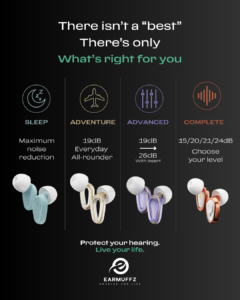
This is where Earmuffz’s approach fits the problem. Rather than positioning earplugs simply as a way to make a room silent, the brand focuses on measurable noise reduction that can make surrounding sound less intrusive. Its adjustable Complete range, for example, allows users to choose between four levels of certified reduction depending on the environment. The aim is not to promise better grades or suggest that students need complete silence to study. It is to give them another way to manage an environment they often cannot control.
One in three Britons sleeps less than seven hours a night. Student halls make it even harder.
The issue does not stop when the books close. According to YouGov’s sleep study of British adults, around 35% of Britons sleep fewer than seven hours per night, with one in eight getting less than six. Noise is one factor that can contribute to disrupted sleep. A review of 74 studies found that every 10-decibel increase in night-time noise approximately doubled to tripled the likelihood of experiencing significant sleep disturbance.
The World Health Organization recommends bedroom noise levels below 30 dB(A) for good-quality sleep, a level that can be difficult to achieve in shared student accommodation. The problem is not limited to students either: 31% of the UK population say their sleep has been affected by unwanted external noise, while a 2024 report on UK student accommodation found that noise ranks among the top three attributes of accommodation affecting student mental health.
For Earmuffz, the proposition is intentionally straightforward: rather than claiming to eliminate noise altogether, its products offer a laboratory-measured and certified reduction in the sound reaching the ear.
Certification gives noise reduction a number you can check
For something as difficult to judge as noise reduction, a number only means something if there is a testing process behind it. In the US, hearing protectors are assigned a Noise Reduction Rating (NRR) under the ANSI S3.19-1974 testing standard. The method dates back more than 50 years and is based on testing with ten subjects in controlled laboratory conditions. That does not mean the number is meaningless. It means consumers need to understand what it represents.
For Earmuffz, certification is more than just a number printed on the packaging. For the UK and European markets, its earplugs carry a Signal to Noise Ratio (SNR) and are certified under Regulation (EU) 2016/425. Hearing protection falls under Category III, the highest risk category for personal protective equipment, alongside products such as fall-arrest equipment. Before products can be sold under this framework, they must undergo type examination against EN 352-2 through an independent notified body, with production also subject to ongoing surveillance. In Great Britain, CE marking under this framework continues to be recognised, so the same certification applies to UK buyers.
For a student buying earplugs, the distinction is fairly simple. There is a difference between a product carrying a tested, traceable noise-reduction rating and one making a broad claim such as “blocks up to 95% of noise.” The former tells you there is a defined testing standard behind the number. The latter tells you very little about how that number was established.
That is the point Earmuffz is making with its certifications. Noise reduction is difficult to judge by looking at a product or trying it for a few seconds. A laboratory-tested rating gives consumers something they can actually verify.
“Students are handed a packing list built around what they can see. Noise is invisible on that list, yet it’s the variable research most consistently links to worse focus and worse sleep. A student who can control what they hear at 11pm has an advantage the rest of the corridor doesn’t.” — Frederick, Spokesperson, Earmuffz
Different environments need different levels of reduction
Earmuffz has built its range around different situations students are likely to encounter, rather than treating every noise problem the same way. Each reusable pair comes with four sizes of food-grade silicone eartips, a spring-open sleek carry case, a two-year warranty and a 100-day return policy.
| Product | Noise reduction | Built for | Price |
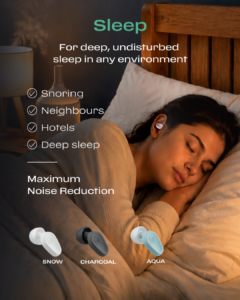
| Sleep — Charcoal / Snow / Aqua | 26 dB SNR, fixed | Overnight wear, side sleepers, snoring flatmates | £35.00 |
| Classic Complete | 15 / 20 / 21 / 24 dB SNR, four switchable levels | Study, lectures, commuting, travel | £44.00 |
| Premium Complete | 15 / 20 / 21 / 24 dB SNR, four switchable levels | As above, upgraded materials | £48.00 |
| Classic Advanced | 19 dB, or 26 dB SNR with the Adventure insert | Focus, deep work, noise sensitivity | £29.00 |
| Premium Advanced | 19 dB, or 26 dB SNR with the Adventure insert | As above, premium build | £35.00 |
| Classic Adventure | 19 dB SNR | Concerts, sports, live events | £21.00 |
| Premium Adventure | 19 dB SNR | As above, premium build | £29.00 |
The Complete range is particularly suited to the changing noise levels students encounter throughout the day. Its four settings can be adjusted without taking the earplug out, allowing a student to use a lower level during a seminar and increase the reduction when nearby conversation becomes distracting. Students who are unsure which model fits their routine can use the Find Your Pair quiz at earmuffz.com.
One for study, one for sleep, and 15% off
Earmuffz is also recommending that students consider two different pairs rather than expecting one product to handle every situation. The requirements are different. During study or class, students may want to reduce surrounding speech while still hearing a lecturer. At night, comfort becomes more important because the earplugs may need to remain in place for eight hours, including while sleeping against a pillow. The brand’s Buy 2, Get 15% Off offer is designed around that combination.
The commonly recommended student pairing of Classic Complete + Sleep costs £67.15 after the discount, with free shipping. Together, the two reusable pairs are positioned as a year-round solution for study and sleep, costing less than 8% of what the average student spends in a single month at university.
Available for the 2026 University season with exclusive discount
All Earmuffz products are available now at earmuffz.com, UK orders over £43.00 qualify for free shipping, and purchases include a two-year warranty and 100-day return period.
Additional information about the brand’s certifications and patents is available at earmuffz.com/certifications-patents.
About Earmuffz
Earmuffz is a certified earplug brand offering reusable earplugs for sleep, focus, travel and live events. Its products carry CE, EN 352-2 and ANSI certifications, include a Signal to Noise Ratio (SNR), and were tested in accredited laboratories in 2025. Every pair comes with four sizes of food-grade silicone eartips, a spring-lock carry case, a two-year warranty and a 100-day return policy. Utility and design patents in China and are pending in the US, the UK and Canada.
Media contact: Frederick Email: media@earmuffz.com
Read Also: techinfobusiness.com