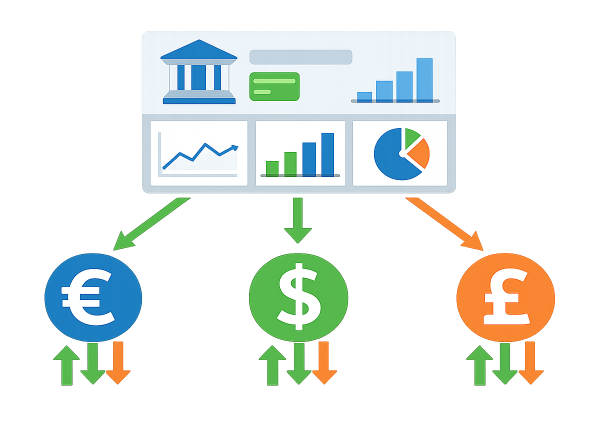
Managing cross-border finances has never been more important for companies seeking to expand globally or work efficiently with international partners. From unpredictable exchange rates to hidden transaction fees, businesses often struggle to keep costs under control. An innovative solution is multicurrency bank account options. These accounts enable companies to hold, receive, and pay funds in multiple currencies, simplifying the process and minimizing expenses.
For businesses navigating international markets, the ability to operate in different currencies is a game-changer. It allows companies to collaborate with suppliers, customers, and employees worldwide without the constant headache of conversions and mounting fees. Adopting a multi-currency approach leads to more transparent financial operations, stronger relationships, and a better bottom line.
Understanding Multi-Currency Accounts
A multi-currency account is designed to support funds in several currencies under one roof. Instead of using separate bank accounts for each currency or dealing with costly intermediary conversions, companies can centralize global funds. This arrangement is particularly beneficial for businesses with international clients or suppliers, as it removes the need to convert every incoming or outgoing payment immediately.
For example, a logistics company that invoices customers in euros, pays suppliers in dollars, and funds payroll in pounds can hold all three currencies in a single account. This flexibility empowers strategic financial planning and helps the company avoid unfavorable exchange rates and unnecessary fees.
Reducing Foreign Exchange Costs
Foreign exchange rates and bank fees can quickly erode profit margins. In a typical banking environment, every time a business receives or makes a payment in a foreign currency, it is subject to conversion charges that are often higher than many expect. Multi-currency accounts help minimize these conversions by allowing funds to remain in the currency for a specific transaction. Businesses can store funds for future payments in the original currency, converting them only when rates are favorable.
For instance, international B2B payment platforms typically charge between 0.2% to 0.3% for cross-border transfers, while traditional banks may charge markup and hidden fees ranging from 4% to 6%. This makes a substantial difference for organizations processing multiple or large transactions each month. According to a recent overview from American Express, using a multi-currency account is one of the simplest ways to avoid excessive charges and increase savings.
Enhancing Cash Flow Management
Holding different currencies gives companies much greater control over their financial pipelines. This means a business can choose the timing of its currency exchanges, taking advantage of favorable rate shifts and avoiding conversions when rates are unfavorable. Cash flow management becomes easier and more predictable, and planned expenditures are no longer at the mercy of daily market fluctuations.
In addition, with funds settling faster through multi-currency accounts, companies experience quicker access to cash. This efficiency enhances working capital cycles by reducing settlement times and supporting better financial decision-making. As Forbes points out, improved cash flow and operational agility can be key competitive advantages in a rapidly evolving global market.
Simplifying International Transactions
Companies active in the global market must often juggle relationships with multiple banks and multiple accounts, one for each currency. This not only complicates monitoring and reconciliations but also increases administrative overhead. Multi-currency accounts consolidate all incoming and outgoing international payments, reducing operational friction. By having clear visibility into global cash balances in a single dashboard, financial teams can generate more accurate reports and make better strategic decisions.
Furthermore, streamlining international transactions through a consolidated multi-currency platform allows businesses to automate routine payments and collections worldwide. For instance, organizations can set up recurring invoices and scheduled payments in customers’ and suppliers’ preferred currencies, slashing the administrative burden and ensuring timely settlements. These automations reduce the risk of missed payments or costly delays, allowing teams to focus on scaling business operations.
Additionally, the ease of integrating multi-currency accounts with modern accounting and ERP software helps businesses synchronize transaction records and track balances in real time. This seamless integration can make year-end audits smoother and provide leadership with immediate insights into revenue streams across different countries. As companies expand and enter new markets, this increased transparency and control deliver a significant operational edge.
Improving Supplier and Customer Relationships
When companies pay suppliers and receive customer payments in local currencies, trust grows, and barriers to smooth transactions fall away. Accepting payments in a partner’s preferred currency can help avoid misunderstandings and delays related to currency conversion. This level of professionalism and convenience encourages productive, long-term partnerships and may even lead to better pricing or more flexible payment terms.
In highly competitive industries, the convenience of seamless multi-currency payments can even act as a unique selling proposition. Suppliers and clients appreciate doing business with organizations that offer flexible, efficient payment options, making them more likely to choose and recommend such partners. For international customers, being invoiced in their local currency enhances clarity, streamlines internal processes, and speeds up payment approval. This simplicity and customer-focused approach can make a critical difference in both customer satisfaction and retention rates.
Mitigating Currency Risk
Currency volatility is an ever-present challenge in international finance. By holding funds in the same currency as revenues or expenditures, companies can hedge against sudden exchange rate fluctuations. This means they are less exposed to unpredictable events that could impact profit margins. Multi-currency accounts offer built-in risk mitigation, making financial outcomes more consistent and planning more reliable.
Companies can also combine multi-currency accounts with advanced risk management tools, such as forward contracts or options, to further hedge exposures. By monitoring currency positions in real time, finance teams can adopt proactive hedging strategies that stabilize cash flows and protect the company’s long-term profitability. This proactive approach is vital in a rapidly changing world where geopolitical and economic shocks can create extreme currency fluctuations overnight.
Conclusion
The era of global business calls for smarter solutions to old problems. With multi-currency accounts, businesses can avoid excessive FX costs, manage cash more effectively, and operate smoothly across international borders. This approach does not just save money. It drives efficiency, transparency, and growth, positioning organizations to thrive in global markets.
Ultimately, adopting a multi-currency account strategy is about future-proofing a business for continued international growth. Whether a company is just starting its expansion abroad or looking to optimize already-established cross-border operations, this financial tool delivers the flexibility, control, and insights needed to succeed in today’s dynamic environment. As globalization accelerates and digital payments continue to reshape commerce, having the right banking infrastructure will remain a crucial differentiator for forward-thinking businesses everywhere.
Read Also: techinfobusiness.com