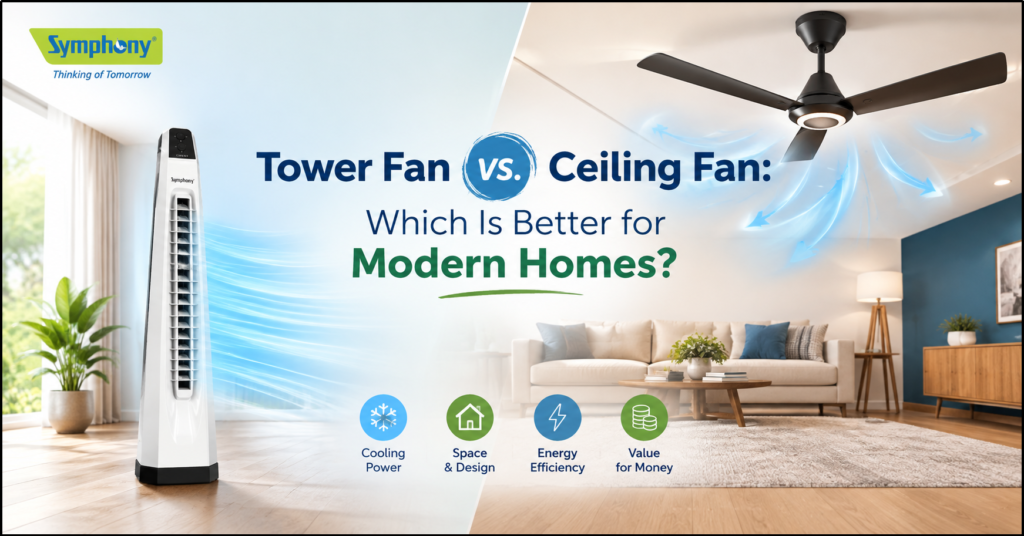
Think about the room where the fan will be used. Does everyone sit in different places, or is the air mainly needed near one bed or sofa? A ceiling fan covers a larger section of the room from above. A tower fan can be kept closer to where you are sitting.
You can move it later if the furniture or room use changes. It does take up some floor space and needs a socket nearby. A ceiling fan avoids this issue but requires installation. Room size alone will not settle the choice. Your seating arrangement and daily use matter just as much.
Start with the Way You Use the Room
A ceiling fan is usually fitted in the centre of a room. The blades move air over a wide area. This makes it practical for living rooms and bedrooms that are used by several people.
A tower fan stands on the floor. You can place it close to the part of the room where air is needed. It may work well beside a study table or near a sofa.
A ceiling fan may be enough when the whole room is occupied. A tower fan may be the better option when only one part of the room is in use.
Airflow Feels Different
A ceiling fan sends air down from above. The airflow then spreads across the room. Its effect depends on the blade size and speed. The height of the ceiling also matters.
A tower fan releases air from a vertical outlet. Many models can turn from side to side. This allows the air to cover a wider section of the room.
The airflow from a tower model is usually more direct. You can point the unit towards a chair or bed. A ceiling fan does not offer the same control over direction.
Both appliances circulate the air already inside the room. While the ceiling fan increases thermal comfort, both can make people feel more comfortable through increased air movement.
A Tower Fan Is Not Always a Tower Cooler
Product names can create confusion. A tower fan normally works without water. It draws in room air and releases it at a higher speed.
A tower cooler has a water tank and cooling pads. Its pump keeps the pads wet while the fan pulls air through them. Some of the water evaporates before the air enters the room.
This type of appliance may also be described as a tower air cooler or an air cooler tower fan. It is generally more useful in hot and dry weather. The room needs ventilation while it is running.
Check the product details carefully. A model described as a cooling tower fan may be a regular fan or a water-based cooler. Look for information about the tank and pump. Cooling pad details will also show whether water is used.
Installation May Decide the Choice
A ceiling fan needs a proper electrical point and secure fitting. There must also be enough space between the blades and nearby cupboards. Installation can be difficult in a rented home or a room with a low or false ceiling.
A tower fan only needs floor space and a nearby socket. When comparing the best tower fan India options, check the full dimensions. The body may be narrow, but the base can be wider. Make sure it fits the chosen place and does not get in the way.
Portability Helps in Smaller Homes
A tower fan can be shifted whenever needed. Keep it in the living room during the afternoon and move it beside the bed later. Check whether its weight and handle make this easy. If it is an air cooler fan, drain the tank first. The added water makes the unit harder to carry and may spill while moving. A ceiling fan remains fixed in the room where it is installed.
Controls and Appearance
Most ceiling fans have simple speed controls. Some newer models also work with a remote. The fan remains visible above the room but does not take up floor space.
Tower fans have a tall and narrow body. Their controls are usually placed on the top or front. Depending on the model, they may include a timer and different air settings. Some also have remote operations.
A timer can be useful at night. It allows the fan to switch off after a selected period. Remote controls are convenient when the unit stands away from the bed or sofa.
People looking for the best bladeless tower fan should still read the product specifications. The term bladeless usually means that moving parts are not exposed at the air outlet. It does not mean that the appliance operates without an internal fan.
Cleaning Need
Dust settles on ceiling fan blades and can be difficult to reach. Turn off the power before using a stool or long-handled duster.
For a tower fan, clean the inlet and outlet with a dry cloth. Check the manual before removing a filter.
A water-based cooler fan needs extra cleaning. Drain the tank when it will not be used for some time. The tank and cooling pads also need regular attention. A standard tower fan is easier to maintain than a tower air cooler because it has no tank or pump.
Price and Electricity Use
Ceiling fan prices vary according to motor type and controls. Installation may add to the initial cost if the room does not already have a suitable connection.
Tower fan prices change with the size and functions. Remote controls and timers can affect the amount you pay. The design of the air outlet may also influence the cost.
The cooler fan price may be higher when the product includes a pump and a large water tank. It also requires more cleaning than a fan without water.
Compare the power rating shown in the product details. The motor size and operating settings can differ.
Before you buy tower cooler models for a home, include the cost of cooling pad replacement in your comparison. Also consider how often the tank will need to be filled.
Tower Fan and Ceiling Fan Comparison
| Point | Tower fan | Ceiling fan |
| Position | Stands on the floor | Fixed to the ceiling |
| Airflow | Directed towards one area | Spread across most of the room |
| Portability | Can move between rooms | Remains in one room |
| Installation | Usually needs only a socket | Requires secure electrical fitting |
| Floor space | Uses a small amount | Uses no floor space |
| Direction control | Easy to aim towards a seat or bed | Direction depends on its fixed position |
| Cleaning | Inlet and outlet need wiping | Blades need regular dusting |
| Water required | No | No |
| Best suited for | Focused airflow and flexible placement | Wider circulation in a regularly used room |
Conclusion
Your room will usually make the choice clear. Use a ceiling fan when air is needed across most of the space. Pick a tower fan for air near a bed or seating area. If you want a model that uses water, check that it is a tower cooler with a tank and cooling pads. A tall design alone does not mean that water is used.